Financial rat race
Job is an acronym for ‘Just Over Broke.’
Workers work hard enough to not be fired, and owners pay just enough so that workers won’t quit.
Most people are trapped in the Rat Race for the rest of their working days. They work for the owners of their company, for the government paying taxes, and for the bank paying off a mortgage and credit cards.
The only way to get out of the “Rat Race” is to prove your proficiency at both accounting and investing, arguably two of the most difficult subjects to master.
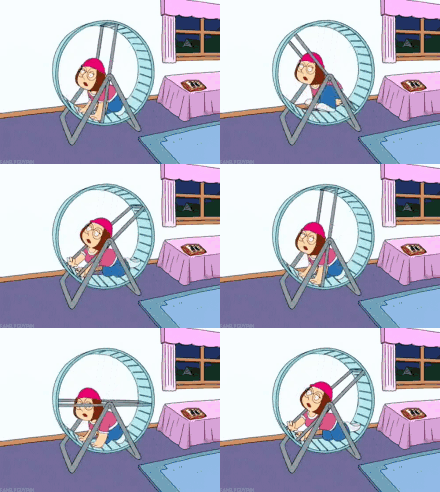
Once people are trapped in the lifelong process of bill paying, they become like those little hamsters running around in those little metal wheels. Their little furry legs are spinning furiously, the wheel is turning furiously, but come tomorrow morning, they’ll still be in the same cage: great job.
Fear and Desire directs people - Avoiding One of Life’s Biggest Traps
Most people, given more money, only get into more debt.
True learning takes energy, passion, a burning desire. Anger is a big part of that formula, for passion is anger and love combined. When it comes to money, most people want to play it safe and feel secure. So passion does not direct them: Fear does.
Just know that it’s fear that keeps most people working at a job. The fear of not paying their bills. The fear of being fired. The fear of not having enough money. The fear of starting over. That’s the price of studying to learn a profession or trade, and then working for money. Most people become a slave to money… and then get angry at their boss."
Each human being has a weak and needy part of their soul that can be bought. Each human being also has a part of their soul that was strong and filled with a resolve that could never be bought. It was only a question of which one was stronger.
Most people have a price. And they have a price because of human emotions named fear and greed. First, the fear of being without money motivates us to work hard, and then once we get that paycheck, greed or desire starts us thinking about all the wonderful things money can buy. The pattern is then set.
“The pattern of get up, go to work, pay bills, get up, go to work, pay bills… Their lives are then run forever by two emotions, fear and greed. Offer them more money, and they continue the cycle by also increasing their spending. This is the Rat Race.”
Most will spend the best years of their lives working for money, not really understanding what it is they are working for.
That’s what the other people do. Just accept a paycheck knowing that they and their family will struggle financially. But that’s all they do, waiting for a raise thinking that more money will solve the problem. Most just accept it, and some take a second job working harder, but again accepting a small paycheck.
Instead of confronting the fear, they react instead of think. They react emotionally instead of using their heads. Then, they get a few bucks in their hands, and again the emotion of joy and desire and greed take over, and again they react, instead of think.
Fear has them in this trap of working, earning money, working, earning money, hoping the fear will go away.
Money is in control of their emotions and hence their souls.
The other emotion is desire. Some call it greed, but I prefer desire. It is perfectly normal to desire. People also work for money because of desire.
The avoidance of money is just as psychotic as being attached to money.
“I’ve met so many people who say, `Oh, I’m not interested in money.’ “I work because I love my job.” Yet they’ll work at a job for eight hours a day. That’s a denial of truth. If they weren’t interested in money, then why are they working? That kind of thinking is probably more psychotic than a person who hoards money.”
Example:
When a person says, “I need to find a job,” it’s most likely an emotion doing the thinking. Fear of not having money generates that thought.
Will a job be the best solution to this fear over the long run? The answer is “no”. Especially when you look over a person’s lifetime. A job is really a short-term solution to a long-term problem.
An education and a job are important. But it won’t handle the fear. That same fear that makes people get up in the morning to earn a few bucks is the fear that is causing them to be so fanatical about kids going to school.
Master the power of money. Not be afraid of it. And they don’t teach that in school. If you don’t learn it, you become a slave to money.
We’re all employees ultimately. We just work at different levels.
If you don’t first handle fear and desire, and you get rich, you’ll only be a high-paid slave.
The main cause of poverty or financial struggle is fear and ignorance, not the economy or the government or the rich.
Most people live their lives chasing paychecks, pay raises and job security because of the emotions of desire and fear, not really questioning where those emotion-driven thoughts are leading them. It’s just like the picture of a donkey, dragging a cart, with its owner dangling a carrot just in front of the donkey’s nose. The donkey’s owner may be going where he wants to go, but the donkey is chasing an illusion. Tomorrow there will only be another carrot for the donkey.
And as you get older, your toys get more expensive. A new car, a boat and a big house to impress your friends. Fear pushes you out the door, and desire calls to you. Enticing you toward the rocks. That’s the trap.
What intensifies fear and desire is ignorance. Money is the carrot, the illusion. If the donkey could see the whole picture, it might rethink its choice to chase the carrot.
A human’s life is a struggle between ignorance and illumination. Once a person stops searching for information and knowledge of one’s self, ignorance sets in. That struggle is a moment-to-moment decision-to learn to open or close one’s mind.
Never forget, your two emotions, fear and desire, can lead you into life’s biggest trap, if you’re not aware of them controlling your thinking. To spend your life living in fear, never exploring your dreams, is cruel. To work hard for money, thinking that money will buy you things that will make you happy is also cruel. To wake up in the middle of the night terrified about paying bills is a horrible way to live. To live a life dictated by the size of a paycheck is not really a life. Thinking that a job will make you feel secure is lying to yourself. That’s cruel, and you need to avoid that trap. Don’t let money run your life."
What does ignorance has to do with greed and fear?
Because it is ignorance about money that causes so much greed and so much fear.
Doctors, wanting more money to better provide for their families, raises their fees. Since the doctors raise their fees, it makes health care more expensive for everyone. Now, it hurts the poor people the most, so poor people have worse health than those with money.
Because the doctors raise their rates, the attorneys raise their rates. Because the attorneys’ rates have gone up, schoolteachers want a raise, which raises our taxes, and on and on and on. Soon, there will be such a horrifying gap between the rich and the poor that chaos will break out and another great civilization will collapse. Great civilizations collapsed when the gap between the haves and havenots was too great. America is on the same course, proving once again that history repeats itself, because we do not learn from history. We only memorize historical dates and names, not the lesson.
Prices should actually come down in an educated society with a well-run government. Prices go up because of greed and fear caused by ignorance.
All too often, business schools train employees who are sophisticated bean counters. Heaven forbid, a bean counter takes over a business. All they do is look at the numbers, fire people and kill the business. All they think about is cutting costs and raising prices, which cause more problems. Bean counting is important but it is not the whole picture.
Thinking would be taking the time to ask yourself a question. A question like, ‘Is working harder at this the best solution to this problem?’
Tags
- Financial literacy and education
- See the node
Making decisions and Taking risks